Online RN-to-BSN Pathway
Bachelor of Science in Nursing Program
Complete your Bachelor of Science in Nursing through a flexible online pathway designed for licensed Registered Nurses.

Degree Earned
Bachelor of Science in Nursing (BSN)
Learning Format
Online, flexible asynchronous coursework
Who Is This For?
Licensed RNs with an Associate Degree in Nursing
Transfer Credit Review
Individual evaluation of RN licensure and prior coursework

Your Path to Earning a BSN as a Registered Nurse
Designed for licensed RNs with an Associate Degree in Nursing, FVI’s RN-to-BSN Pathway builds on prior nursing education and licensure while developing the advanced knowledge associated with baccalaureate nursing practice.
Eligible nursing education, RN licensure, and general education coursework may be recognized through an individual transfer-credit evaluation.
Complete asynchronous online coursework while balancing your professional and personal responsibilities.
Expand your knowledge in nursing leadership, research, community and population health, informatics, health assessment, and health promotion.
Expand Your Professional Nursing Opportunities
BSN-level education can expand professional nursing knowledge in leadership, community and population health, care coordination, informatics, and preparation for future graduate study.

Leadership
Develop leadership skills to support teams, improve care quality, and contribute to evidence-informed decision-making.

Community Health Nursing
Apply prevention, education, and health-promotion strategies to address the needs of communities and diverse populations.

Care Coordination
Strengthen communication and collaboration across care teams to support continuity, safety, and patient-centered outcomes.

Nursing Informatics
Use health information systems, data, and digital tools to support clinical decisions, communication, and quality improvement.

Population Health Practice
Examine population-level trends, social determinants of health, and strategies that promote health equity.

Graduate Nursing Education Preparation (MSN/DNP)
Build a stronger academic foundation for future graduate nursing study and continued professional development.

Earn Your RN to Bachelor of Science in Nursing Degree
When Is the Right Time for RNs to Earn a BSN?
The decision to earn a BSN usually connects to something specific: a career goal, an employer expectation, or a change in what you want from your nursing career.
Job Postings Prefer or Require a BSN
Some hospitals, healthcare systems, and specialized departments prefer or require BSN-level education for certain nursing roles. If positions you're interested in consistently list a bachelor's degree, your current credentials may be limiting your options.
You're Considering Graduate Nursing Education
Many MSN and doctoral nursing programs require a bachelor's degree for admission. If you're thinking about becoming an advanced practice nurse, nurse educator, or nurse administrator, a BSN is typically a prerequisite.
Your Employer Offers Tuition Assistance
Healthcare organizations sometimes provide tuition reimbursement or education stipends for nurses pursuing a bachelor's degree. Check with your HR department or nursing leadership to find out what your employer offers.
You're Asking, “What's Next?”
Some nurses reach a stage where they want to grow professionally but feel limited by their current credentials. Earning a BSN can expand the range of roles and responsibilities available to you.
You Want to Move Into Leadership or a Specialty
Roles like charge nurse, nurse supervisor, clinical coordinator, and nurse educator involve responsibilities that extend beyond direct patient care. BSN coursework in leadership, communication, and evidence-based practice can strengthen your preparation.
FLEXIBLE BY DESIGN
Designed for Working Registered Nurses
FVI’s RN-to-BSN Pathway is designed for licensed Registered Nurses balancing work, family, and continued education. Asynchronous online coursework provides scheduling flexibility, while individual transfer-credit evaluation considers eligible prior education and RN licensure.
You’ve already handled the demands of nursing school and clinical practice. This pathway builds on that experience. Coursework focuses on BSN-level knowledge in leadership, research, community health, and related areas. The focus is on what comes next in your nursing education, not on repeating what you’ve already learned.
To help keep you on track, FVI’s Success Coaches and academic advisors are available to work with you one-on-one from enrollment through completion of the program.

How Transfer Credit Evaluation Works
Your prior education is the starting point for your personalized transfer-credit evaluation. FVI reviews each applicant individually to determine which eligible prior coursework and credentials may apply toward the RN-to-BSN Pathway.
1. Submit Your Information
Provide the required transcripts and information about your nursing education and RN licensure.
2. Receive an Individual Review
FVI evaluates eligible nursing and general education coursework according to current academic and transfer-credit policies.
3. Understand Your Remaining Requirements
Your evaluation will identify accepted transfer credit, the courses you still need to complete, and the next steps in your RN-to-BSN pathway.
Transfer credit is not guaranteed and is determined through an individual evaluation under applicable FVI academic policies.
Based on current transfer-credit policies:
- 51 credits may be awarded for RN licensure
- Up to 33 eligible General Education transfer credits
- FVI ASN graduates receive 75 credits toward the BSN pathway
- Maximum allowable transfer credit, including eligible coursework from other institutions: 87 credits
- Students may need to complete as few as 33 credits at FVI depending on transfer evaluation

RN-to-BSN Knowledge and Skills
FVI’s RN-to-BSN Pathway helps licensed Registered Nurses strengthen the advanced knowledge and professional skills associated with baccalaureate nursing practice. Students explore evidence-based care, leadership, population health, informatics, ethics, and health promotion through focused BSN-level coursework.

Leadership, Ethics & Professional Practice
Strengthen leadership, ethical reasoning, professional accountability, scope-of-practice awareness, and interdisciplinary collaboration.

Advanced Health Assessment & Pathophysiology
Deepen your understanding of health assessment, disease processes, risk factors, and health promotion across diverse populations.

Community & Population Health
Examine community needs, prevention strategies, health equity, and approaches that support population-level outcomes.

Evidence-Based Nursing & Research
Apply research findings and evidence-based approaches to support informed nursing practice and quality improvement.
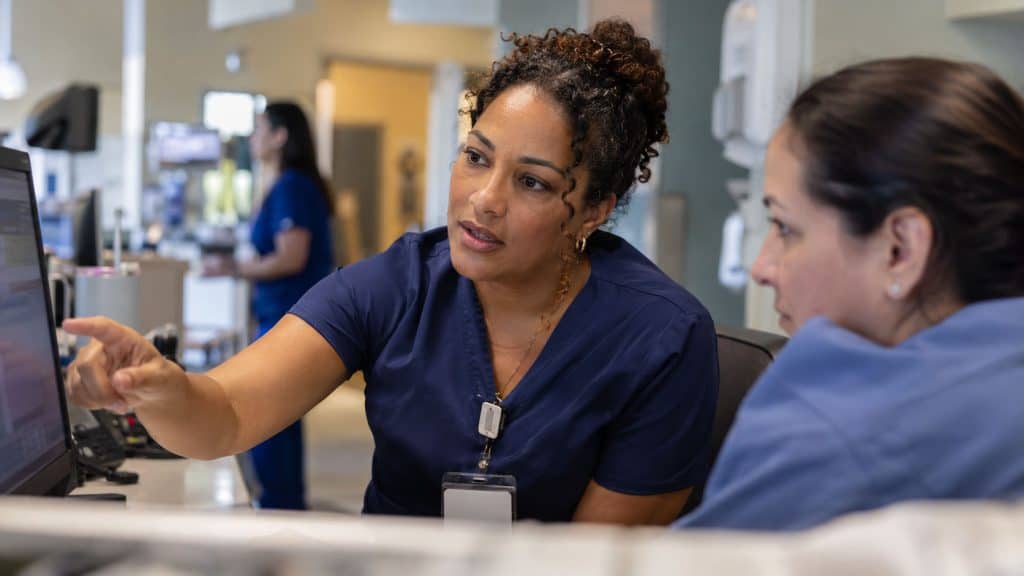
Nursing Informatics
Use health information, digital tools, and data to support communication, clinical decision-making, and coordinated care.
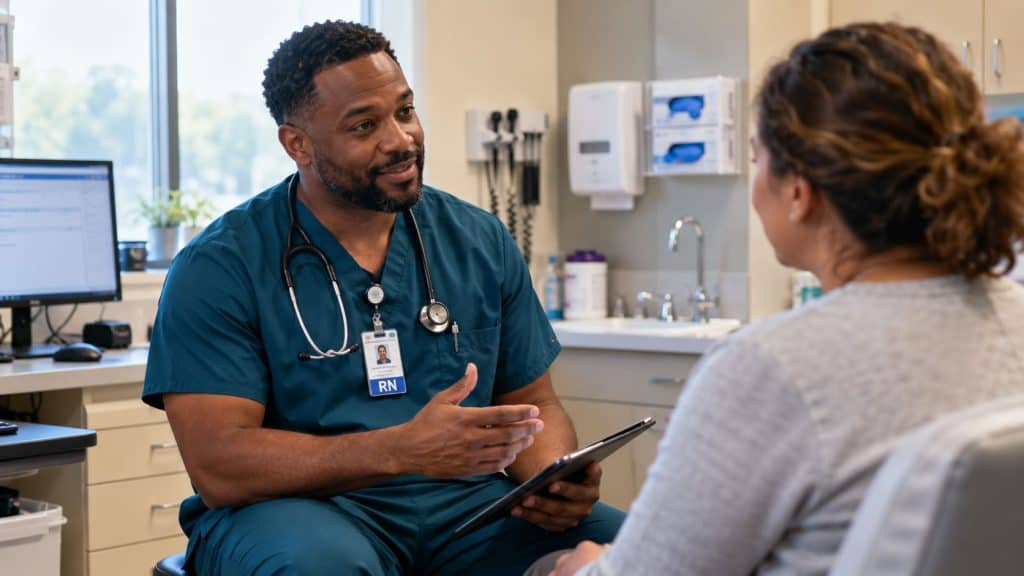
Health Coaching Across the Lifespan
Support patient education, behavior change, aging-related needs, and culturally responsive care across the lifespan.
Accreditations and Partnerships
FVI School of Nursing and Technology is licensed by the State of Florida Commission for Independent Education and institutionally accredited by the Accrediting Commission of Career Schools and Colleges (ACCSC).
FVI maintains partnerships with healthcare organizations across South Florida, including Holy Cross, Pediatrics Associates, and Memorial Health.








Online RN-to-BSN Learning Experience
Complete your General Education and BSN Core coursework online through an asynchronous learning format designed for working Registered Nurses. Engage in instructor-led courses that strengthen leadership, research, informatics, community health, and evidence-based nursing practice while allowing you to balance work, family, and continued education.
Ready to Learn More About the RN-to-BSN Pathway?
Online RN-to-BSN Program Curriculum
The RN-to-BSN Pathway includes General Education completion requirements and BSN Core coursework. Eligible prior coursework may transfer based on individual evaluation.
General Education Completion — 16 Credits
- Chemistry for Health Science with Lab — 4 credits
- English Composition II — 3 credits
- Ethics, Technology, and Society — 3 credits
- Foundation of Statistical Methods — 3 credits
- Human Nutrition for Health and Wellness — 3 credits
BSN Core Coursework — 30 Credits
- Advanced Health Assessment and Holistic Health Promotion — 3 credits
- Nursing and the Aging Family — 2 credits
- Nursing Research and Evidence-Based Practice — 3 credits
- Ethical and Legal Aspects of Nursing Practice — 3 credits
- Diverse Community & Population Health Nursing — 4 credits
- Professional Nursing Roles and Scope of Practice — 3 credits
- Pathophysiology for Nursing Practice — 3 credits
- Nursing Informatics and Technology — 3 credits
- Nursing Leadership and Management — 3 credits
- Professional Role Transformation RN-to-BSN Capstone, Lecture — 2 credits
- Professional Role Transformation RN-to-BSN Capstone, Clinical Practicum — 1 credit
Delivery Format
- General Education coursework — asynchronous online; eligible courses or equivalents may transfer following individual evaluation
- BSN Core coursework — asynchronous online, except for the hybrid capstone clinical practicum
- Capstone Clinical Practicum — direct and indirect experiential learning completed locally based on the student’s residence

Admission Requirements
The RN-to-BSN Pathway is designed for licensed Registered Nurses who have completed an Associate Degree in Nursing. Our Admissions Team will review your academic background and guide you through the eligibility and transfer-credit evaluation process.
01
Active RN License
Hold an active and unencumbered Florida RN license.
02
Nursing Degree
Have earned an Associate of Science in Nursing degree from an accredited institution.
03
Official Transcripts
Submit official transcripts from all colleges and universities attended for academic and transfer-credit evaluation.
04
Transfer Credit Evaluation
Complete an individual transfer-credit evaluation.
05
Academic Requirement
Minimum cumulative GPA: 2.50.
Financial Aid & Scholarships
Financing your continued nursing education is an important part of planning your next step. FVI’s Financial Aid team can help you understand the options that may be available to those who qualify, including federal grants and student loans, guide you through the FAFSA process, and identify available scholarships and payment plans.
Already working as a nurse? You may also want to ask your employer whether tuition reimbursement, education assistance, or other professional-development benefits are available.

RN-to-BSN Questions, Answered
Considering RN-to-BSN programs in South Florida? Find answers about eligibility, online learning, transfer-credit evaluation, and the next steps toward completing your BSN.
Who is the RN-to-BSN Pathway designed for?
The pathway is designed for licensed Registered Nurses who have earned an Associate Degree in Nursing and want to complete a Bachelor of Science in Nursing.
Do I need to be a Registered Nurse before applying?
Yes. Applicants must hold an active and unencumbered RN license.
Is the RN-to-BSN Pathway online?
Yes. General Education and BSN Core coursework are delivered online in an asynchronous format. The pathway also includes a 2-credit Capstone Practicum.
For nurses looking for an RN-to-BSN school in Florida, FVI offers the flexibility to complete coursework online while continuing to work.
How many FVI credits are in the RN-to-BSN Pathway?
The pathway includes 45 FVI credits. Depending on individual transfer evaluation, some students may need to complete as few as 33 credits at FVI.
How much transfer credit may be accepted?
The current academic structure allows up to 87 transfer credits, subject to individual transcript review and transfer evaluation.
What credit do FVI ASN graduates receive?
The current academic structure provides FVI ASN graduates with 75 credits toward the BSN pathway, subject to final approved transfer policies.
How does the transfer-credit evaluation work?
Does the RN-to-BSN pathway include clinical training?
The RN-to-BSN Pathway is not a pre-licensure clinical nursing program. It includes a limited 2-credit Capstone Practicum. Final practicum details are pending confirmation.
Can the RN-to-BSN Pathway support preparation for graduate nursing education?
The curriculum includes BSN-level coursework in leadership, research, community health, informatics, and related professional nursing areas that can support preparation for graduate nursing education such as MSN or DNP programs.
Is it worth it to get a BSN?
That depends on your professional goals. A BSN can expand the range of nursing positions available to you, strengthen your knowledge in areas like leadership and evidence-based practice, and meet prerequisites for graduate nursing programs. Some healthcare employers prefer or require BSN-level education for certain roles.
If career flexibility and continued professional growth are important to you, earning a BSN could be a practical next step.
Do BSN nurses make more?
Education level is one of several factors that can influence a nurse’s compensation. Others include years of experience, geographic location, employer, specialty area, and certifications.
Some positions that prefer or require a BSN may offer different compensation levels than entry-level RN roles. Earning a BSN does not guarantee a higher salary.
How long does RN to BSN take?
Your time to completing the program will depend on your individual transfer-credit evaluation and remaining course requirements. The RN-to-BSN Pathway includes 45 FVI credits, and depending on how much eligible prior coursework transfers, some students may need to complete as few as 33 credits.
A personalized transcript review can help you understand the requirements that may apply to you. Contact FVI’s Admissions Team for a more specific estimate based on your academic background.
What will it cost me? Will my hospital pay for a BSN?
Your education costs will depend on your individual program requirements and transfer-credit evaluation. See FVI’s Consumer Information page or speak with Admissions for the most current tuition and fee information.
Some hospitals and healthcare organizations may offer tuition reimbursement, education assistance, or other benefits for employees continuing their education. Check with your employer or human resources department to learn what may be available to you.
FVI’s Financial Aid team can walk you through the options available to those who qualify, including federal grants, student loans, scholarships, and payment plans.
Do ASN credits transfer to BSN?
Eligible prior nursing and general education coursework may be accepted toward FVI’s RN-to-BSN Pathway following an individual transfer-credit evaluation. Transfer credit is not guaranteed.
Under the current academic structure, FVI ASN graduates receive 75 credits toward the BSN pathway, subject to final approved transfer policies. Additionally, 51 credits may be awarded for RN licensure, and up to 33 eligible General Education credits may transfer from other institutions. All transfer credit is determined through individual evaluation under FVI’s academic and transfer-credit policies.
What opportunities does a BSN open up?
BSN-level education can prepare nurses to pursue a broader range of professional roles, including nursing leadership, case management, community and public health, quality improvement, clinical education, care coordination, and specialized hospital departments.
A BSN can also meet the academic prerequisites for graduate nursing programs such as MSN or DNP pathways.
Do I actually need a BSN?
Many Registered Nurses build long careers with an associate degree. A BSN is not required to maintain your RN license or to practice as a Registered Nurse. However, some employers and healthcare systems prefer or require BSN-prepared nurses for certain positions, and certain career paths may require bachelor’s-level education.
Whether you need a BSN depends on your goals, your employer’s expectations, and where you want your nursing career to go.
Ready to Take the Next Step?
Request a personalized review of your transcripts and prior nursing education to understand how they may apply toward the RN-to-BSN Pathway.