

Emergency medical services keep communities safe every day. In Florida, where population growth, tourism, and an aging population drive constant need, both EMTs and paramedics play essential roles on the front lines of healthcare.
If you are thinking about a career in EMS, one of the first questions people ask is: what is the difference between an EMT and a paramedic? This blog breaks down the training, scope of practice, pay, work settings, and advancement options to help you decide which path might be a better fit with your goals. Many professionals begin as EMTs and later move up to becoming paramedics, so starting with EMT training is a practical first step.
EMT vs. Paramedic: Big Picture Comparison
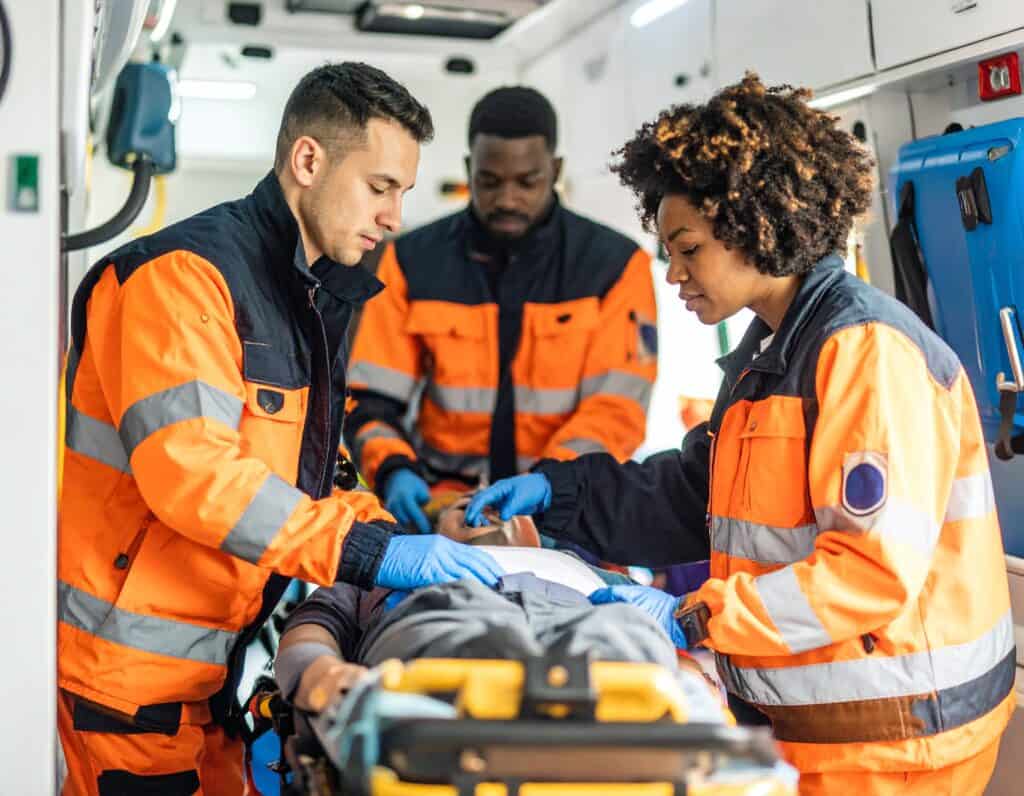
When someone calls 911 for a medical emergency, an ambulance is dispatched to wherever the patient is: a highway crash, a home, a workplace, a nursing facility, or anywhere else. EMTs and paramedics are the first responders who ride in those ambulances and provide care before the patient ever reaches the hospital. This is called pre-hospital or out-of-hospital emergency care.
An EMT is the entry-level clinician. They arrive on scene:
- Perform rapid assessments
- Control bleeding
- Give oxygen
- Perform CPR
- Transport the patient safely to the emergency department.
Training for this job can take as little as four months, so it is a fast way to start working in emergency medical services.
A paramedic is the highest-level pre-hospital clinician. Paramedics ride on the same ambulances (usually paired with an EMT) but can perform far more advanced procedures
- Start IVs
- Administer dozens of medications
- Interpret EKGs
- Intubate patients
- Treat life-threatening conditions right there on scene
To become a paramedic, you must first gain experience as an EMT and then complete one to two years of additional training.
In short: EMTs stabilize and transport. Paramedics stabilize and treat aggressively in the field. According to the Bureau of Labor Statistics (May 2024), EMTs earn a national median wage of $41,340 while paramedics earn $58,410, with strong demand for both roles across Florida and the country.
Work Settings and Roles
Both EMTs and paramedics often work full-time shifts that include nights, weekends, and holidays. Common settings include:
- EMTs: municipal or private ambulances, hospital emergency departments (as ER techs), event standby, and some fire departments
- Paramedics: 911 ALS ambulances, fire-based EMS, critical care transport, helicopter programs, and tactical or disaster response teams
Training and Education Differences
EMT training is designed to get you into the field quickly. Most programs require only a high school diploma or GED. You complete a state-approved course that follows national standards, covering patient assessment, CPR, basic airway management, bleeding control, and limited medications. The entire process usually takes 4–6 months. After the course, you sit for the National Registry of EMTs (NREMT) exam or a state-approved test to become licensed.
Paramedic training builds directly on EMT certification. You must already hold an EMT license before enrolling. Programs run 1–2 years and include hundreds of hours of classroom, lab, clinical, and field internship time. Coursework dives deeper into anatomy, pharmacology, cardiology, advanced airway management, and trauma care. Graduates take the National Registry Paramedic exam.
Scope of Practice and Daily Responsibilities
EMTs provide Basic Life Support. On a typical call, an EMT:
- Performs rapid patient assessments
- Controls bleeding and immobilizes injuries
- Administers oxygen and uses an AED
- Assists with a small list of medications (such as aspirin or epinephrine auto-injectors, depending on state rules)
- Safely transports patients to the hospital
Paramedics provide Advanced Life Support and can perform everything an EMT does plus:
- Start IVs and give a wide range of medications
- Interpret EKGs and treat cardiac emergencies
- Perform advanced airway procedures (intubation, supraglottic devices)
- Make more complex treatment decisions in the field
Salary and Job Outlook
The national median annual wage (as of May 2024) is $41,340 for EMTs and $58,410 for paramedics, according to the Bureau of Labor Statistics. Pay varies by location, employer, and experience. In Florida, factors such as population increase and growth of the healthcare industry create steady openings for new EMTs and paramedics.
Florida’s population grows rapidly every year, bringing in hundreds of thousands of new residents and one of the nation’s largest retiree communities. Older adults have more falls, heart events, and chronic conditions that require fast EMS response. Millions of tourists also visit beaches, theme parks, and events each year, especially in Miami and Orlando. This steady influx of visitors leads to additional accidents, heat illnesses, and sudden emergencies that keep local ambulance teams busy.
Healthcare systems are also expanding in Florida, with new hospitals, urgent care centers, and outpatient facilities opening to meet the needs. At the same time, ongoing staffing shortages mean teams need more first responders to handle the volume without delays. Nationally, BLS projects about 5% growth for EMTs and paramedics from 2024 to 2034, but Florida’s unique mix of growth and tourism often leads to even more opportunities here.
Career Advancement Opportunities
Many people use EMT certification as a stepping stone. From EMT, common next moves include:
- Becoming an Advanced EMT (AEMT)
- Enrolling in a paramedic program
- Transitioning to nursing (ASN or BSN) or other healthcare roles
Paramedics often specialize in critical care transport, flight medicine, community paramedicine, or move into supervisory and education positions.
Why Start with an EMT Program?
If you want to enter emergency medical services quickly and start gaining real-world experience, EMT training is an excellent entry point. At FVI School of Nursing and Technology, the Emergency Medical Technician program in Florida takes just 16 instructional weeks and prepares students to sit for the National Registry EMT exam, a required step for licensure.
Note: Graduation does not guarantee employment or licensure.
The convenient hybrid format combines live online instruction with hands-on skills labs, realistic simulation experiences, and clinical rotations at approved sites. Flexible day, night, and weekend schedules allow you to fit the program around work and other life responsibilities.
Classes are offered at our EMT school in Miami (bilingual Spanish/English) and EMT school in Miramar (English). Small class sizes let you work closely with dedicated and experienced faculty, while our career support services team provide job-search support for students: resume guidance and interview preparation.
Ready to take the first step in EMS? Contact us today to speak with an admissions advisor and learn how FVI can help you begin your career as an EMT in Florida.
EMTs vs. Paramedics: At-a-Glance Comparison
| EMT (Emergency Medical Technician) | Paramedic | |
| Level | Entry-level | Highest pre-hospital level |
| Typical training time | 120–150 hours (a few months) | 1,200–1,800 hours (1–2 years) |
| Education requirement | High school diploma/GED + approved EMT course | Must first be an EMT + accredited paramedic program |
| Scope of practice | Basic Life Support (BLS) | Advanced Life Support (ALS) |
| Median annual wage (BLS, May 2024) | $41,340 | $58,410 |
| Job growth (2024–2034) | 5% (combined with paramedics) | 5% (combined with EMTs) |
| Common next step | Advanced EMT or paramedic | Critical care, flight medic, nursing, leadership |
(Data from the U.S. Bureau of Labor Statistics)